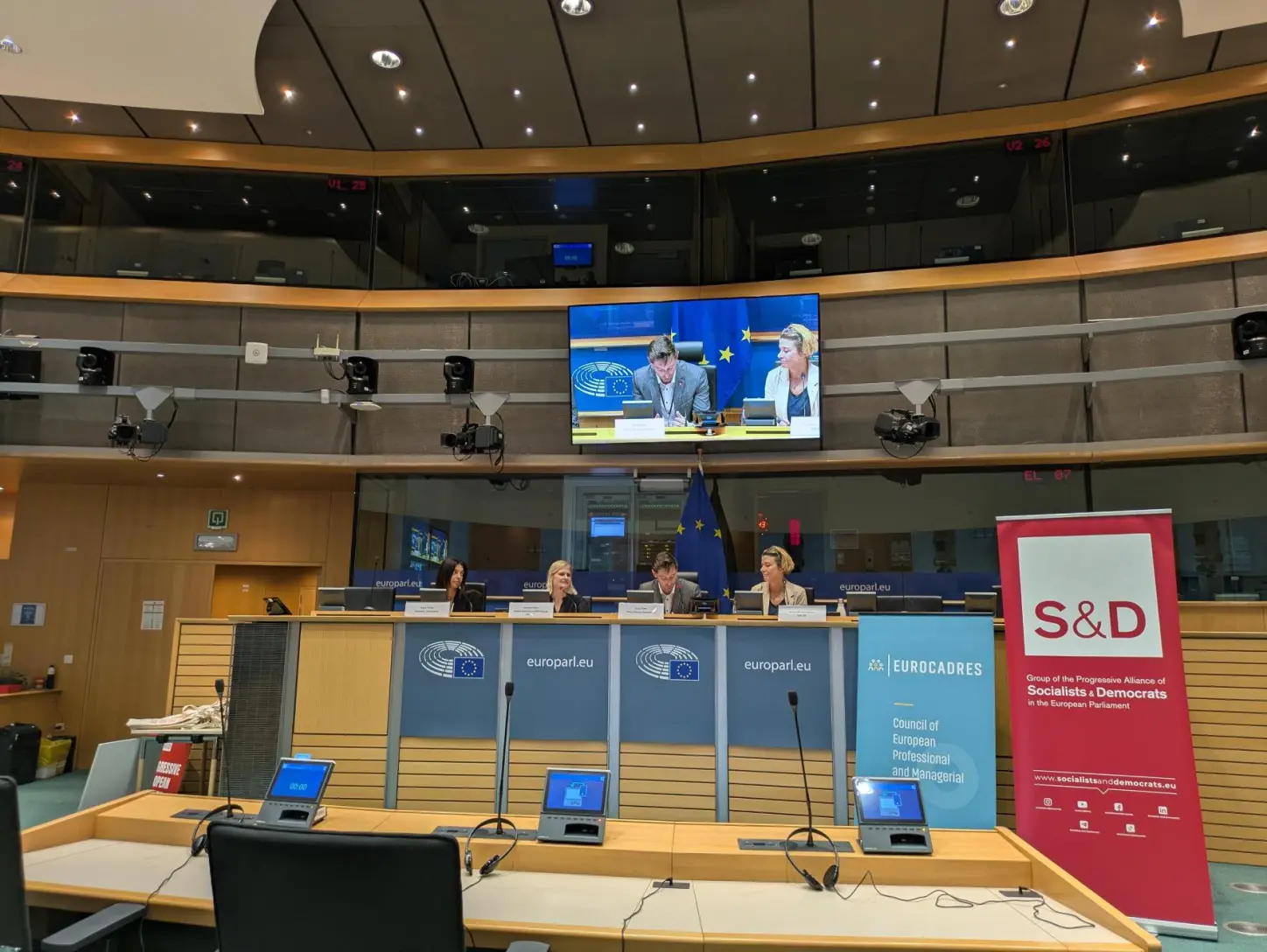
At a European Parliament event on psychosocial risks at work organised by S&D MEP Estelle Ceulemans and Eurocadres on 30 September, ETUCE European Director Jelmer Evers highlighted the growing psychosocial risk crisis affecting teachers, academics and other education personnel across Europe.
The event came at a particularly timely moment as on 2 September the European Parliament’s Committee on Employment and Social Affairs (EMPL) adopted a legislative-initiative report calling on the European Commission to put forward dedicated EU legislation on work-related psychosocial risks.
During his intervention, Jelmer Evers stressed that psychosocial risks in education are not isolated challenges but structural problems affecting education systems across Europe. Drawing on evidence from the recent 2026 EU-OSHA Report on psychosocial risks in education and 2025 ETUCE-EFEE Report on Occupational wellbeing in European education systems, he highlighted the impact of excessive workload, work intensification, staff shortages and increasing workplace pressures on the education profession. The scale of the challenge is reflected in the latest EU-OSHA report on psychosocial risks in education, which found that almost 50% of lower secondary teachers in Europe experience work-related stress, while 24% report that their work negatively affects their mental health.
ETUCE underlined that workload and work intensity remain among the main psychosocial risks facing education workers. Teachers are increasingly expected to take on responsibilities beyond teaching, including responding to students' social and emotional needs, while education systems continue to suffer from chronic underinvestment, staff shortages and insufficient support personnel. Administrative tasks continue to be identified as one of the leading sources of stress. In higher education and research, academics and researchers face additional pressures linked to precarious employment and the persistent "publish or perish" culture. ETUCE also highlighted the lack of professional autonomy and meaningful social dialogue in education. According to the evidence presented, only 18% of European teachers feel they have influence over teacher and education policies that affect their work, underlining the need to involve education workers more meaningfully in decision-making processes.
The organisation also highlighted the growing challenges linked to digitalisation. While digital tools bring important opportunities, they are also contributing to increase work intensity and create expectations of permanent availability. In this context, ETUCE stressed the importance of the recently agreed autonomous agreement on the right to disconnect in education and the need for stronger protections against the negative effects of constant connectivity.
The EU-OSHA report also found that nearly 80% of educational establishments identify difficult students and parents as a major psychosocial risk. ETUCE warned that teachers and other education workers are increasingly exposed to verbal abuse, threats, harassment, bullying, cyberbullying and other forms of violence, both online and offline. At the same time, education workers are often expected to respond to students' growing mental health needs without adequate support structures, training or specialist staff in place.
"Psychosocial risks in education are not individual problems that workers must manage alone. They are structural challenges that require structural solutions. Through social dialogue, stronger prevention measures and a strong European framework on psychosocial risks, we can create healthier and more attractive education professions for current and future generations." Jelmer Evers, ETUCE Director
ETUCE urged the European Commission, the European Parliament and Member States to advance work on a legislative framework for psychosocial risks, establish an enforceable European right to disconnect and place education workers' wellbeing at the centre of efforts to address teacher shortages. ETUCE also reiterated its call for a comprehensive EU Teachers' Agenda that supports recruitment, retention and sustainable working conditions across the education sector. As a next step, the EMPL report is expected to be put to a vote during the European Parliament’s October plenary session.
Psychosocial risks in education: Understanding work-related factors affecting teachers’ well-being